


:quality(80))


:quality(80))


:quality(80))


:quality(80))


How Zamnesia activates 250M visitors a year across 11 storefronts
:quality(80))
Read summarized version with
 ChatGPT
  Perplexity
  Gemini
  Claude
  Grok
Grok 
About Zamnesia
Zamnesia, run by Just Amazing BV, is one of Europe's most recognised online smartshops. Founded in Amsterdam around 2011, the company sells cannabis seeds, functional mushroom products, vaporizers, alternative botanicals and home-growing supplies directly to consumers, and has served well over a million customers. What started as an ambitious project, run from a small living room, has blossomed into a globally renowned company, with localized storefronts running across Europe and an expansion into the United States launched in late 2024.
Zamnesia's growth model rests on very high-traffic content and category pages, fed by years of SEO authority, brand recognition and a deep educational library of grow guides and product resources. That traffic is the company's biggest asset, and its biggest activation opportunity.
Company size
Industry
Use cases
Features used
Enterprise
D2C smartshop / specialty e-commerce
Always-on new-customer capture
Gamified discovery campaigns
Seasonal and thematic promotions
Multi-market activation from one workspace
Operational messaging and re-engagement
Popups
In-page embeds
Gamification (spin-to-win, scratch cards)
Web push
A/B testing
Multi-site / multi-market workspace
Results at a glance
Huge traffic, dozens of markets, and a website that treated every visitor the same
Like many content-rich D2C brands, Zamnesia had solved acquisition long before it solved activation. Search, brand and a vast educational catalogue brought millions of sessions to the site every month. But once a visitor arrived, the experience was broadly undifferentiated: the same pages served a first-time grower researching a strain, a returning customer ready to reorder, and a seasonal bargain-hunter, with little onsite logic to move any of them forward.
That gap is expensive. Every unactivated session is a visitor the business already paid to acquire through SEO investment, content production and paid channels. With organic search driving the bulk of traffic, Zamnesia's challenge was less about getting more visitors and more about converting the ones it already had, the layer between acquisition and conversion was where the value was leaking.
The operational dimension made it harder. Zamnesia runs 11 country storefronts in different languages, with different promotional calendars, pricing and local regulations. Any solution had to let a small marketing team launch, localise and test onsite campaigns across all of them from one place, without engineering work for every change, and without each market becoming its own manual project.
We don't have a traffic problem, search and our content bring millions of people to the site. Our opportunity is what happens once they arrive. Wisepops is the layer that actually does something with that traffic, market by market.
Zamnesia
1. Always-on new-customer capture, localised per market
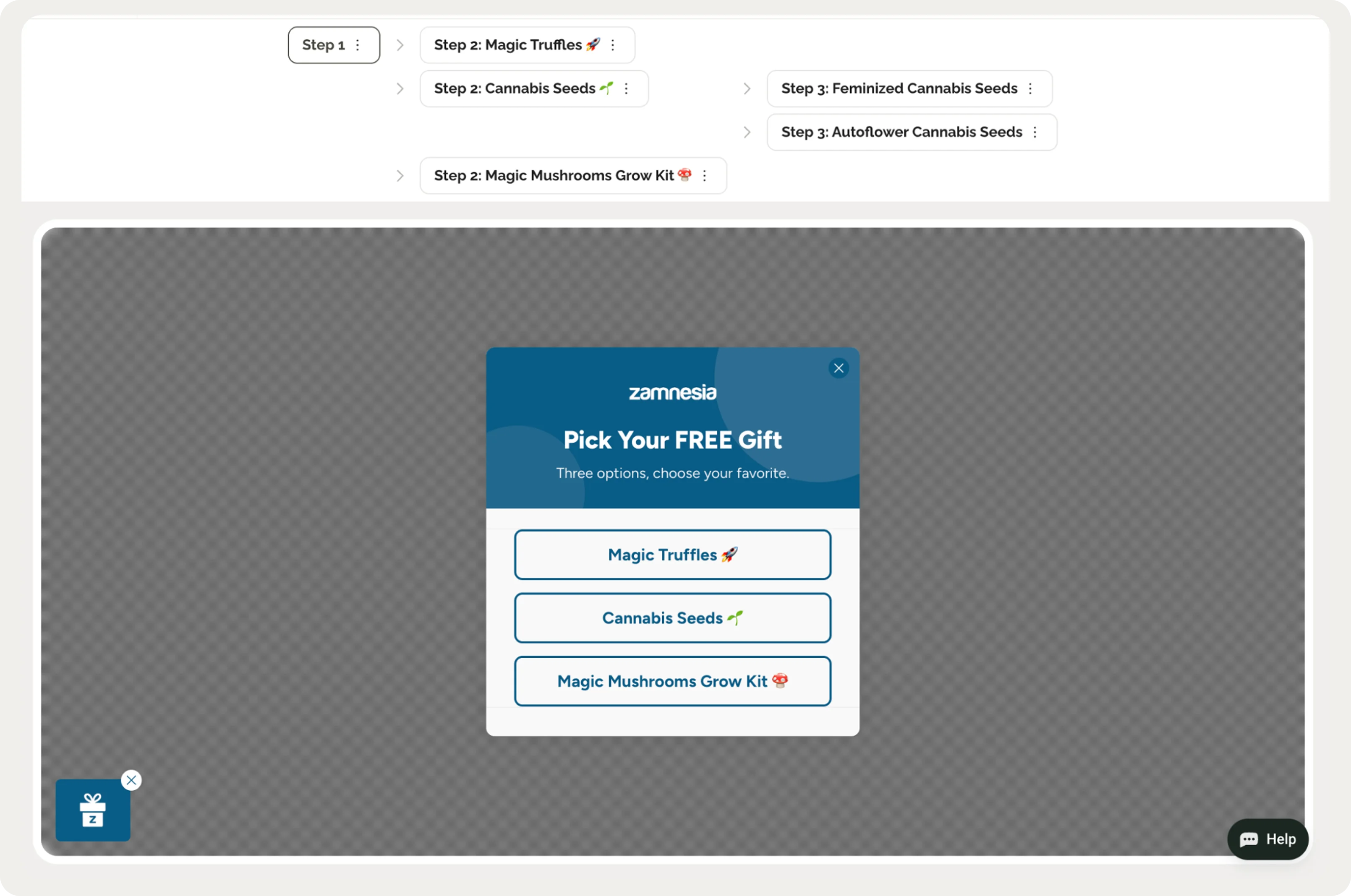
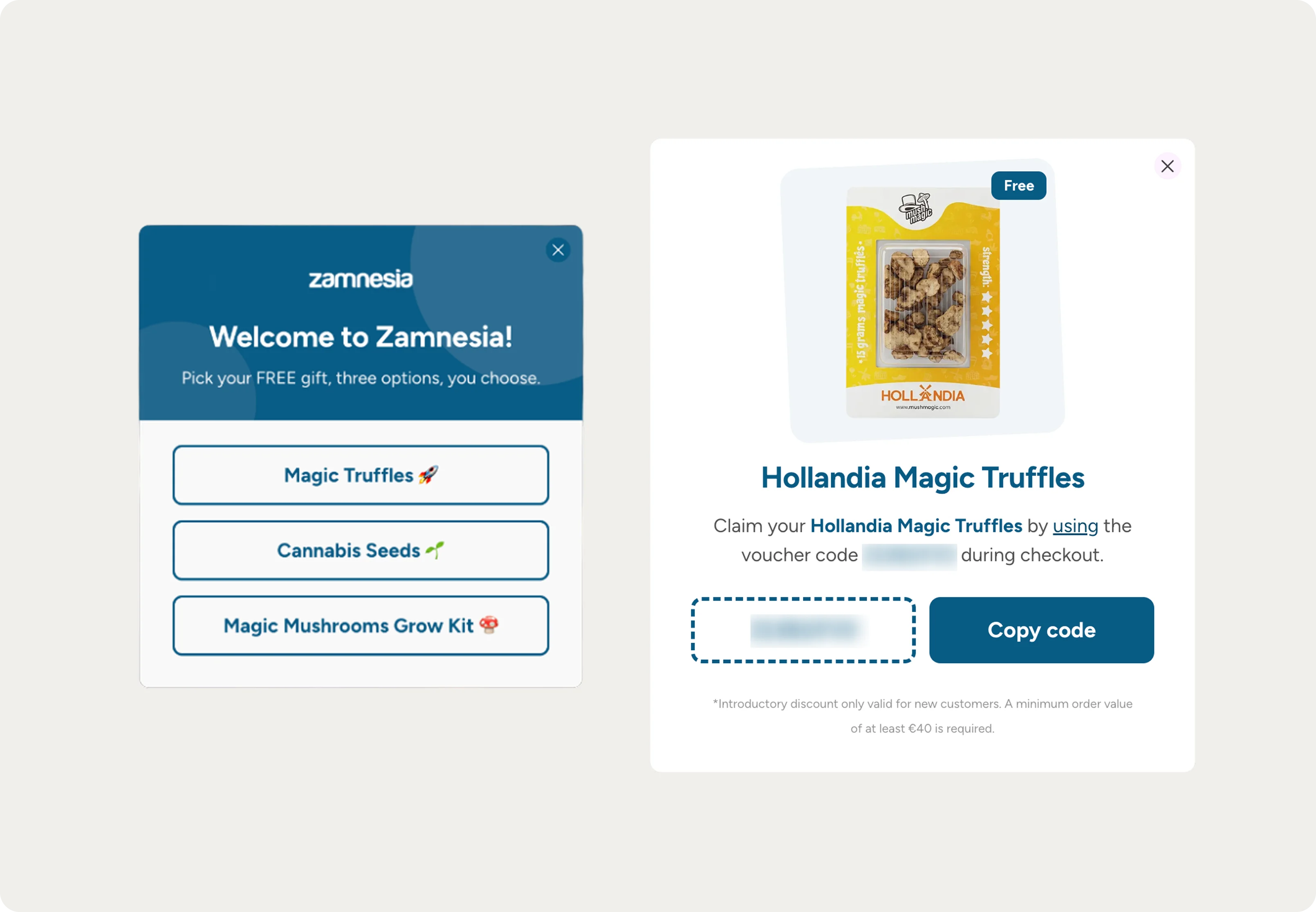
The foundation of Zamnesia's programme is an always-on welcome offer that runs continuously across every active storefront. New visitors are met with a first-order incentive and an email capture step, localised in each market's language and currency, while returning and CRM-sourced visitors are filtered out so existing customers never see an acquisition offer.
This single use case is what makes the multi-market story work: the same proven campaign logic is templated once and rolled out across 11 storefronts, rather than rebuilt market by market. It is also the workhorse behind the 153,000+ contacts the programme has collected, the majority from the German, French and English-language storefronts where the setup is most mature.
The offer itself is a tested variable, not a guess. A head-to-head test on the German storefront pitted a free-product welcome offer against a flat €10 discount: the free-product framing reached a 15.8% engagement rate versus 7.2% for the cash discount, more than double, on tens of thousands of impressions each. The lesson Zamnesia took from it is that, for this audience, a tangible free product beats an equivalent cash saving, the kind of insight that only surfaces when you can test at real volume.
2. Gamified discovery - and why the format matters more than the offer
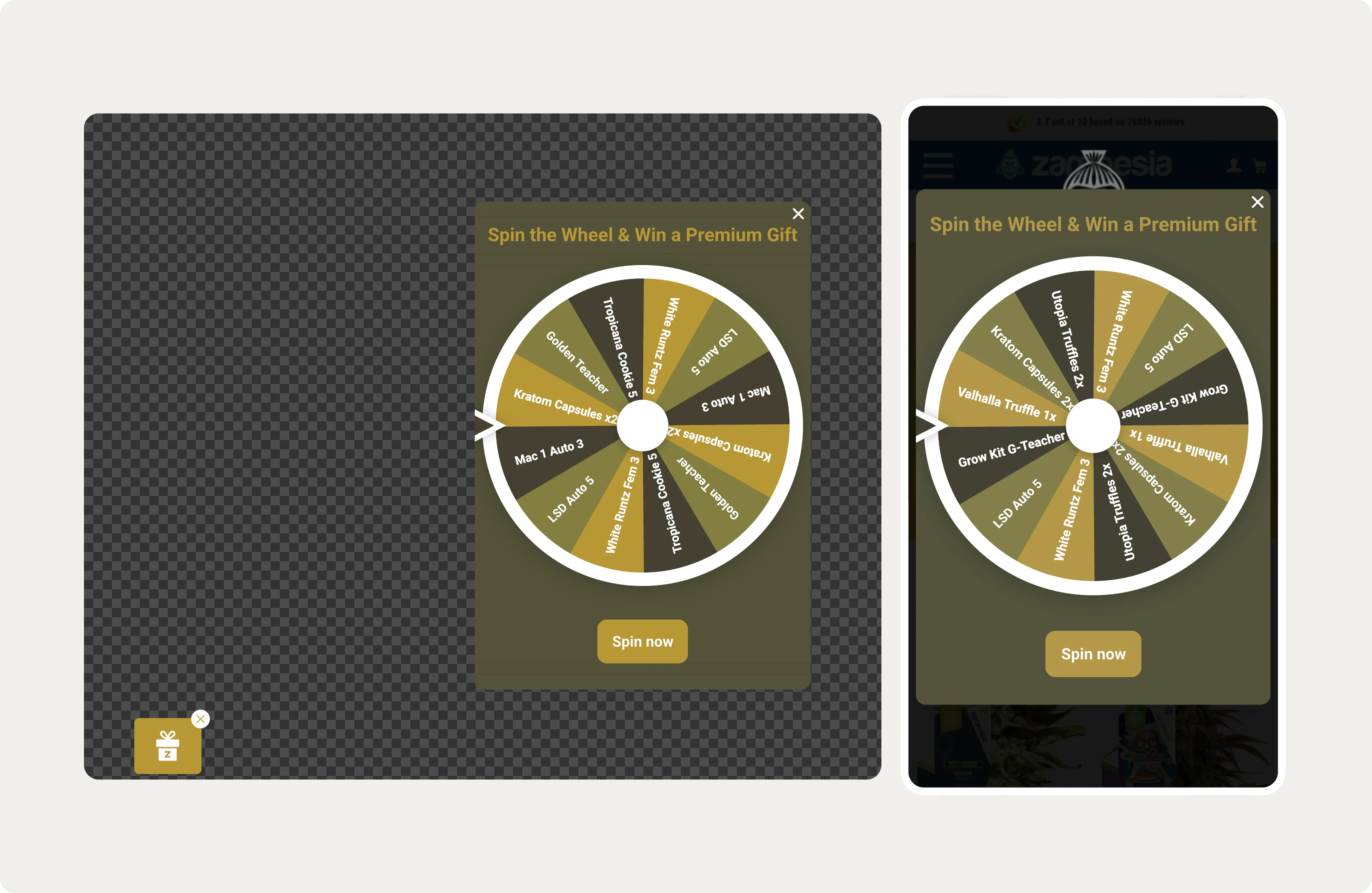
Zamnesia leans heavily on gamified discovery: spin-to-win wheels, scratch cards and themed reveal mechanics tied to the brand's playful identity. Rather than ask for an email up front, these campaigns invite the visitor to play first, turning a passive impression into an active moment of intent before any commitment is requested.
The single sharpest lesson in the account is about where that game appears. Zamnesia ran the same Tribe Week spinning-wheel offer in two forms, and the contrast is dramatic: as a standard interruptive popup the wheel engaged visitors at roughly the same single-digit-to-low-teens rate as the rest of the account, but delivered as a native, in-page experience the enhanced wheel reached a 71.3% engagement rate. Same offer, same audience, same brand, close to 10x the engagement, purely from moving the activation into the page instead of interrupting on top of it.
This is the heart of why Zamnesia treats Wisepops as a traffic activation layer rather than a popup tool. The format is not decoration; it is the lever. Meeting a visitor inside the browsing experience, at the moment they are already paying attention, consistently outperforms an interruption, and it is the pattern the team now reaches for first on high-intent pages.
3. A year-round seasonal and thematic calendar
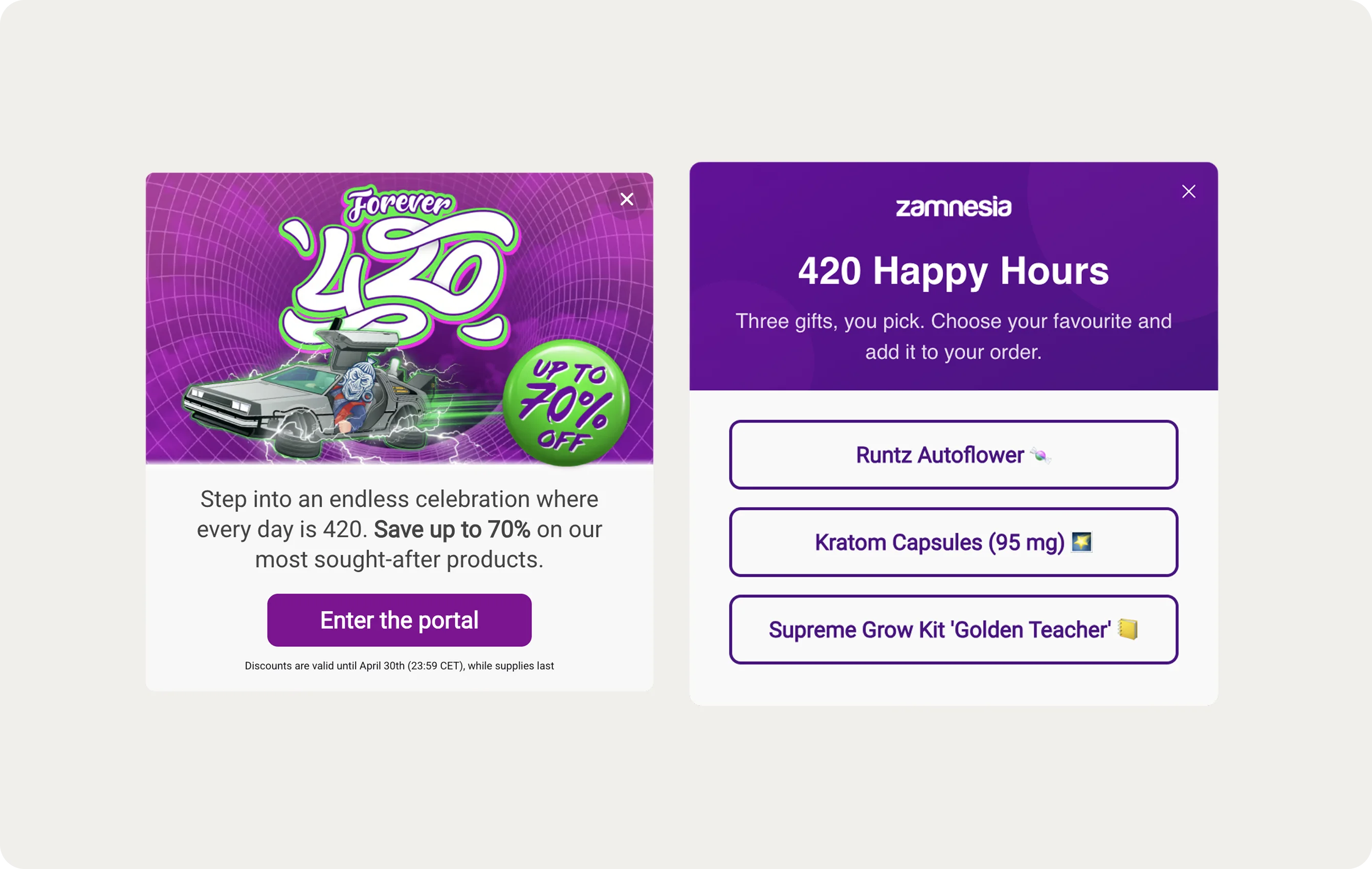
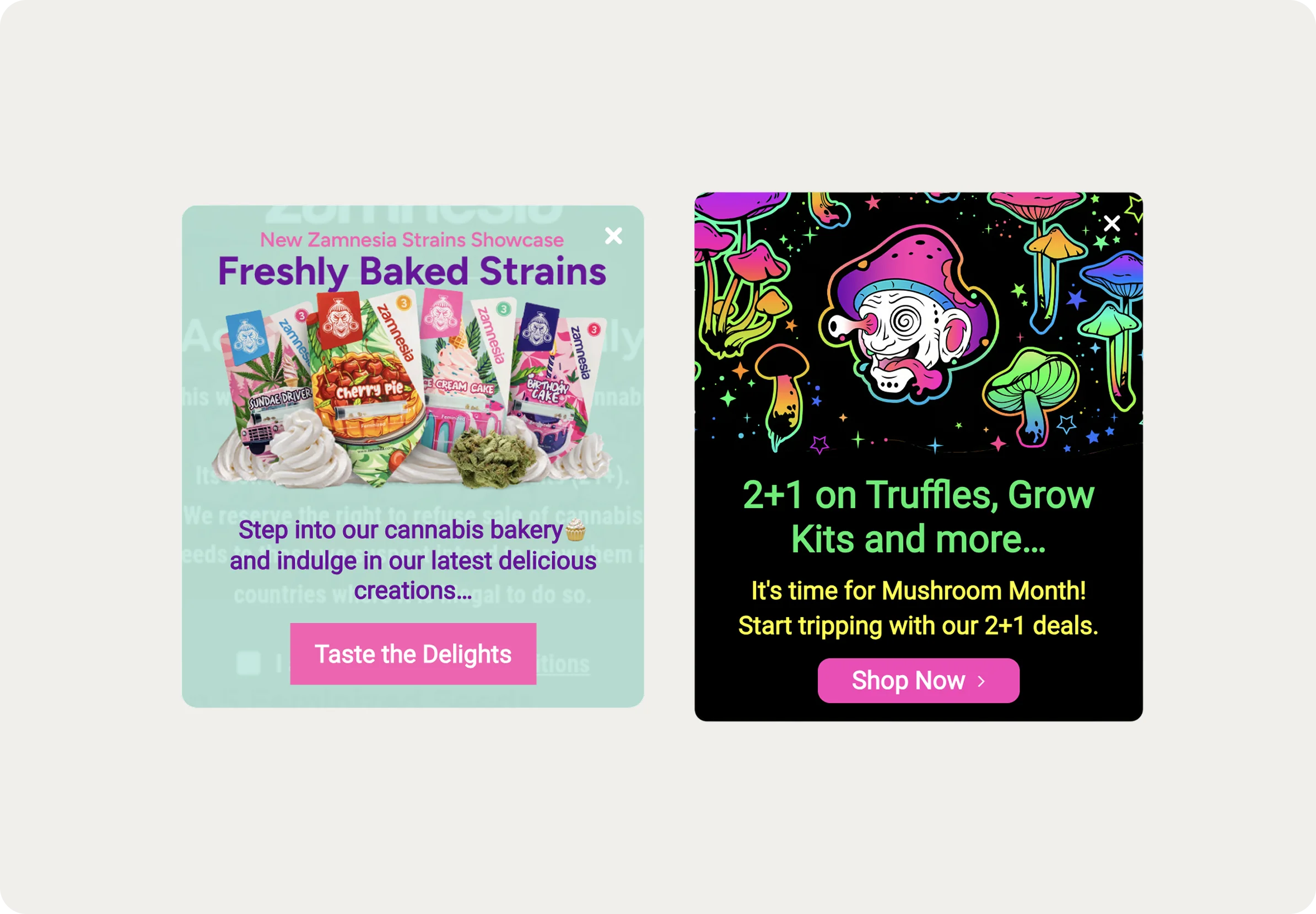
Beyond always-on capture, Zamnesia runs a continuous calendar of time-limited campaigns mapped to both retail moments and its own brand world: Mushroom Month, Tribe Week, Summer Specials, Singles Week, 420 and the recurring Zamnesia Islands events, each with localised creative per market. Themed campaigns regularly outperform the always-on baseline, several seasonal pushes cleared 14-18% engagement, comfortably above the account's already-strong 16.8% average and well beyond the 3-5% industry norm.
The calendar is also where the team's test-and-learn discipline compounds. Discount-depth tests (for example 10% vs 12% vs 15%), timing tests and creative variants run continuously, with winners folded into the next seasonal wave. The result is a programme that improves season over season rather than resetting each time.
4. One workspace, 11 storefronts, mixed deployment
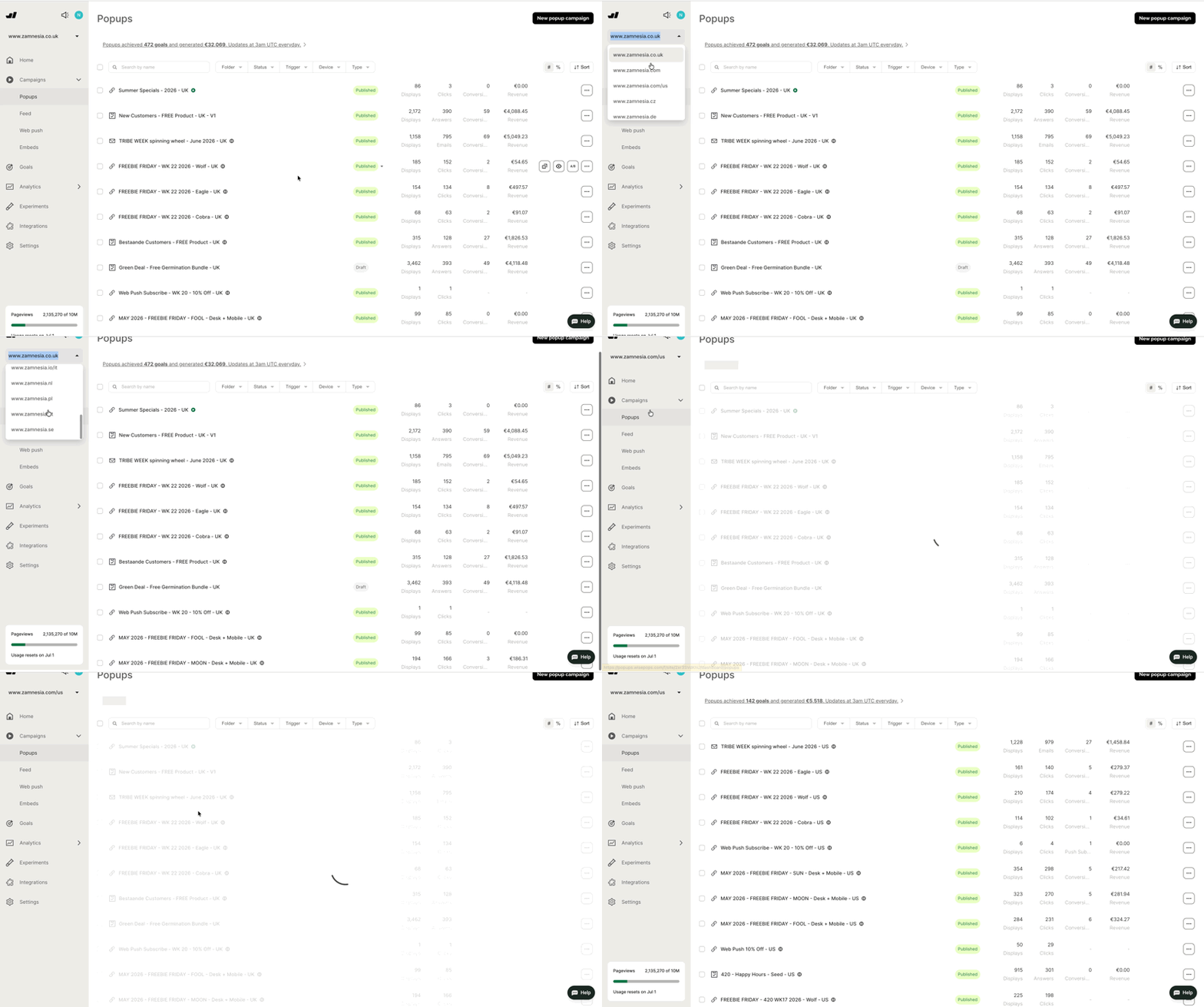
Zamnesia manages every market from a single Wisepops workspace, storefronts spanning the Netherlands, Germany, France, Spain, Italy, the UK, the US, and a wave of newer European markets (Portugal, Poland, Czechia) launched in late 2025. Each site runs its own localised campaign set while sharing templates, logic and reporting across the account, so a new market can adopt the proven playbook from day one rather than starting from scratch.
Deployment is deliberately flexible. Most markets run via tag manager for full marketing control without touching site code, while integrated markets unlock store-level revenue goal tracking. That flexibility is what lets a single team operate at this breadth, and is why newly launched storefronts are already collecting contacts within weeks of going live.
5. Operational messaging and re-engagement
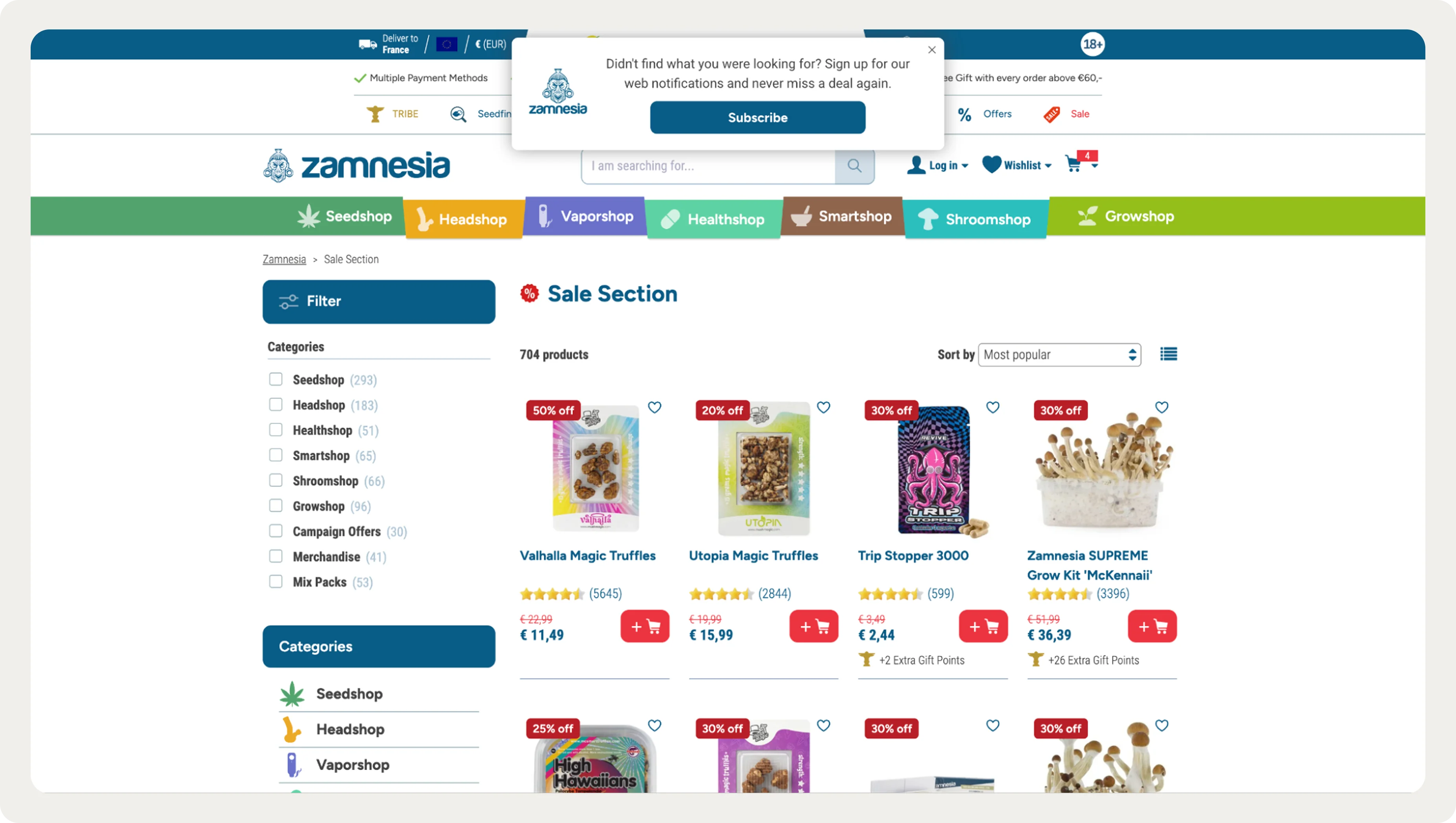
The same activation layer is built to carry more than promotions. Beyond temporary shipping and delivery-delay notices, Zamnesia is now implementing custom properties to extend Wisepops into operational communication, surfacing answers to common questions around voucher codes, shipping costs and order status at the right moment. The platform has also begun using web push (71 campaigns to date, engaging at around 12%) to re-engage visitors after they leave.
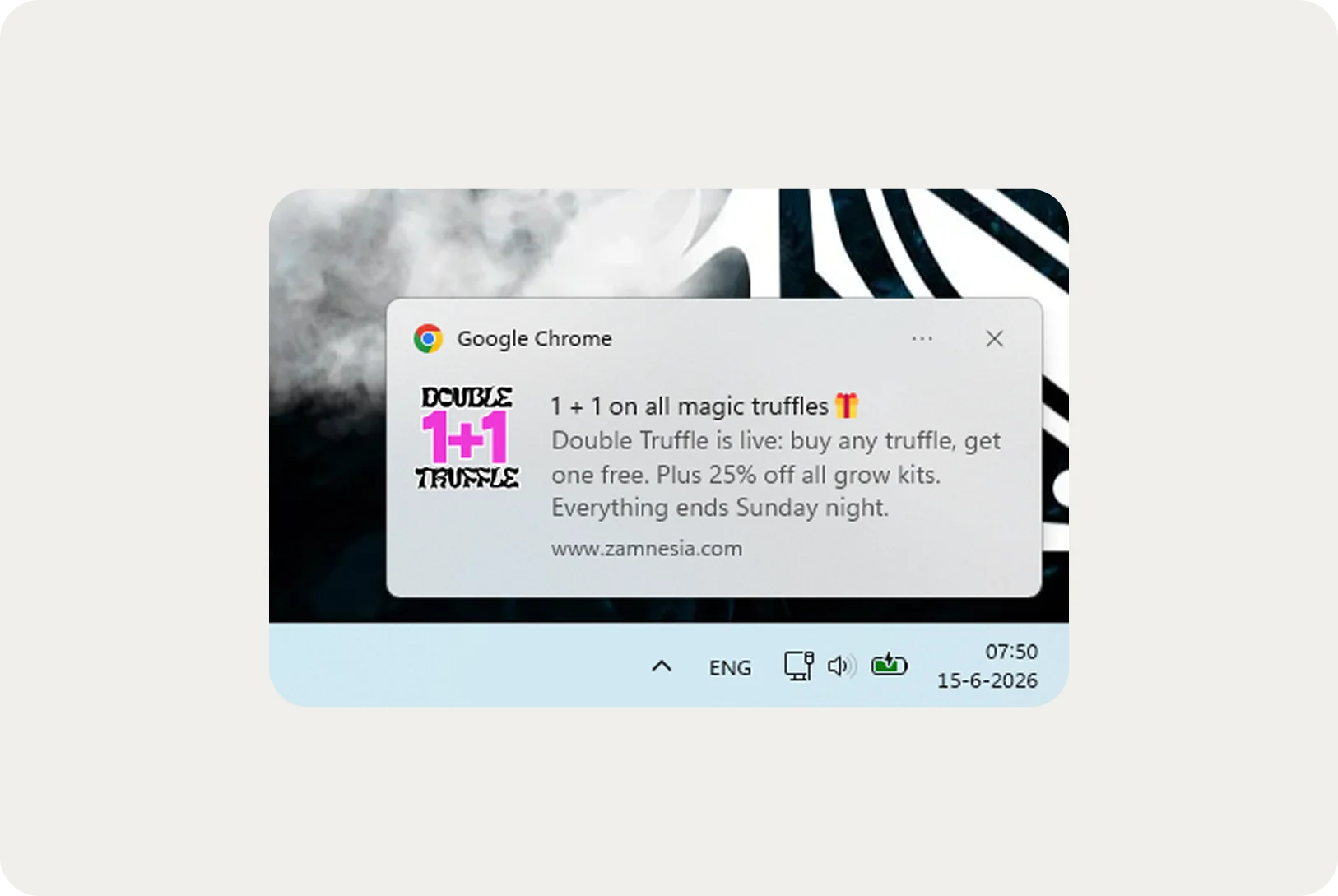
The biggest surprise was how much the format mattered. The same offer in the page instead of on top of it changed engagement completely. That's when it stopped being a popup tool for us and became part of how the site works.
Zamnesia
From first popup to full activation layer
2021 - First markets live. Zamnesia launches onsite capture across its core European storefronts (NL, DE, FR, ES, UK and the .com), starting with a single format and a focused new-customer offer.
2023-2024 - Scaling breadth and testing depth. The seasonal calendar fills out, structured A/B testing becomes routine, and the US storefront launches in 2024 on the same proven playbook.
Late 2025 - Market expansion. New European storefronts (PT, PL, CZ) come online, each deploying the templated campaign set from day one, with SE, DK and FI slated to activate in 2026.
2026 - A true activation layer. The programme now spans three formats (popups, web push and in-page embeds), email capture has roughly tripled since 2024, and Wisepops-influenced revenue reaches 17.4% of online sales in its strongest quarter.
What makes Zamnesia's approach work
They treat onsite as the layer between acquisition and conversion
With SEO and brand already delivering traffic, Zamnesia's gains come from converting visitors it has already paid for, not from buying more. Activation is treated as a revenue channel, not a widget.
Format is a lever, not a detail
The same offer hitting 71% engagement in-page versus single digits as a popup is the clearest proof: Zamnesia wins by choosing where and how to activate, not just what to offer.
One playbook, fourteen markets
A templated, test-driven programme run from one workspace means every new storefront inherits years of learning instantly, breadth without proportional headcount.
What's next
Having built a deep popup and gamification practice, Zamnesia's natural next step is to push further into the formats it has only just begun using. In-page embeds, already proven to deliver step-change engagement on the spinning wheel, are the obvious area to expand onto product and category pages, alongside a wider web push programme for post-visit re-engagement and richer revenue attribution coverage across more markets as integrated tracking rolls out. The foundation is in place; the next phase is depth.
Get started
today
Within 7 days of installing our tracker, we’ll deliver a personalized audit with identified opportunities and their estimated revenue impact. No commitment.
More customer stories

eTeacher Group turned expensive paid traffic into 90K+ named contacts using lead magnets.

How a global fitness brand built a product-discovery quiz that engages 9 in 10 visitors.
PMI uses Wisepops as the activation layer between acquisition and conversion across its global digital footprint.