


:quality(80))


:quality(80))


:quality(80))


:quality(80))


Ecommerce Lead Generation: 8 Proven Strategies to Convert More Traffic
:quality(80))
:quality(80))
Read summarized version with
 ChatGPT
  Perplexity
  Gemini
  Claude
  Grok
Grok Key takeaways
In ecommerce lead generation, the biggest opportunity is not more traffic, but converting existing visitors through better onsite experiences.
Timing, targeting, and personalization drive performance. While the average popup converts at 4.8%, high-intent campaigns can exceed 50%.
High-performing onsite campaigns rely on flexible tools that support precise targeting, testing, and performance tracking.
The real value of lead generation comes after the signup, when onsite interactions feed email, SMS, and lifecycle marketing flows.
Traffic isn't the problem. Most ecommerce stores already have more visitors than they can convert.
The real challenge is what happens next. Too many users browse, consider, and leave without leaving any trace: no email, no phone number, no way to bring them back.
That's where ecommerce lead generation becomes critical: turning anonymous traffic into people you can reach again. Once that connection exists, sales don't have to happen in a single visit.
In this article:
Reach the right visitors at the right time
We review your traffic and show which campaigns can reach more visitors and which targeting options would help you reach your goals.
:quality(80))
8 onsite strategies to boost ecommerce lead generation and signup rates
Most of the following strategies can be implemented quickly and tested right away.
1. Make a first strong impression with a welcome popup
This is your first and best chance to capture attention before visitors decide whether to stay or leave.
A well-crafted welcome popup introduces value immediately and gives visitors a reason to share their details. Popups shown after 11 to 15 seconds tend to perform best, achieving conversion rates as high as 6.45%.
Nutrimuscle ran an A/B/C test to find the best format, landing on a 3-step popup:
Step 1: collect the visitor's email
Step 2: collect phone number, ask about their sport and training frequency
Step 3: show a discount code with personalized product recommendations
The result: a 4.1% signup rate and 7,000+ new email subscribers in 12 months.
:quality(80))
:quality(80))
:quality(80))
2. Capture abandoning visitors
When users are about to leave, you have one last chance to collect their contact details with an exit-intent popup. At this stage, simplicity outperforms creativity.
The exit-intent popup can take many forms:
Countdown timer: creates urgency with a limited-time offer
Yes/No micro-commitment: encourages a small action to keep visitors engaged
Lead magnet: offers downloadable content or resources
Cart abandonment reminder: highlights products left in the cart
Feedback quiz: asks visitors why they're leaving
:quality(80))
3. Personalize for returning shoppers
Treating returning visitors like new ones wastes the context you've already earned.
Instead of repeating the same message, use tailored prompts based on prior behavior, such as pages viewed or past interactions. The table below shows behavior-based targeting campaigns that work well for return visitors:
Campaign
Trigger
Offer / hook
Why it works for return visitors
Discount for email
2nd+ visit, no purchase
"Still thinking it over? Get 10% off your first order"
Return visits signal genuine interest; a discount removes the last barrier without wasting it on cold traffic
Back-in-stock alert
3+ views of same out-of-stock product
"Want to know when this is back? Drop your email."
High purchase intent already established: opt-in is frictionless because the ask is purely practical
Loyalty / VIP early access
4th+ visit, not subscribed
"You've been here a few times, join our list for early sale access"
Framing the opt-in as a reward for loyalty converts habitual browsers who haven't felt urgency yet
Abandoned browse recovery
Exit intent after product page view
"Save this item + get 10% off: enter your email and we'll hold it for you"
Combines a save mechanic with lead capture; return visitors are far more likely to convert than first-timers
Yespark, a parking space rental company, applied this approach by combining a welcome popup for new visitors with a bar message for returning users, adapting the experience to each stage of familiarity.
Impact: 4,737 new signups, including 3,492 from first-time visitors and 1,245 from returning users. The difference came down to timing and relevance: new visitors received an incentive to join, while returning users saw a lighter, contextual reminder aligned with their prior interest.
:quality(80))
:quality(80))
4. Gamify the signup experience
Instead of asking for information upfront, collect it progressively while users engage with quizzes, spin-to-win popups, and other interactive formats:
Easter egg hunts drive site exploration through hidden rewards
Advent calendars encourage repeat visits with daily unlocks
Treasure hunts turn browsing into an interactive experience
Scratch cards create instant excitement with surprise rewards
The key is that users engage before they're asked to convert.
A strong example is émoi émoi, which used a gamified "Mama Festival" campaign to turn email signups into a fun, brand-aligned experience. Visitors could spin a colorful prize wheel featuring giveaways, downloadable content, free delivery, and discounts in exchange for their email address.
The result: a 17% signup rate, generating more than 8,000 new subscribers in just one month. The campaign also drove over 900 coupons redeemed.
:quality(80))
5. Lead with value, not only discounts
Not every conversion needs a discount.
In many cases, visitors are more motivated by relevance than price cuts, especially when brands offer something genuinely useful or inspiring. Early access, expert guidance, personalized recommendations, exclusive content, or design inspiration can all drive signups when aligned with what the visitor is already looking for.
This approach works especially well for luxury and premium brands that don't rely as heavily on discounts, as discounts can sometimes backfire by lowering the average order value.
Vepsäläinen, a leading furniture and home decor brand in Finland, combined seasonal promotions across popups and embeds with value-driven content like design inspiration to grow their list without disrupting the browsing experience.
Result: over 8,000 new leads collected with a 17% signup rate in just eight months.
:quality(80))
6. Capture intent on product pages
Interest peaks on product pages, where visitors are actively deciding what to buy. Placing a message here allows you to capture leads while intent is high, without interrupting the experience too early.
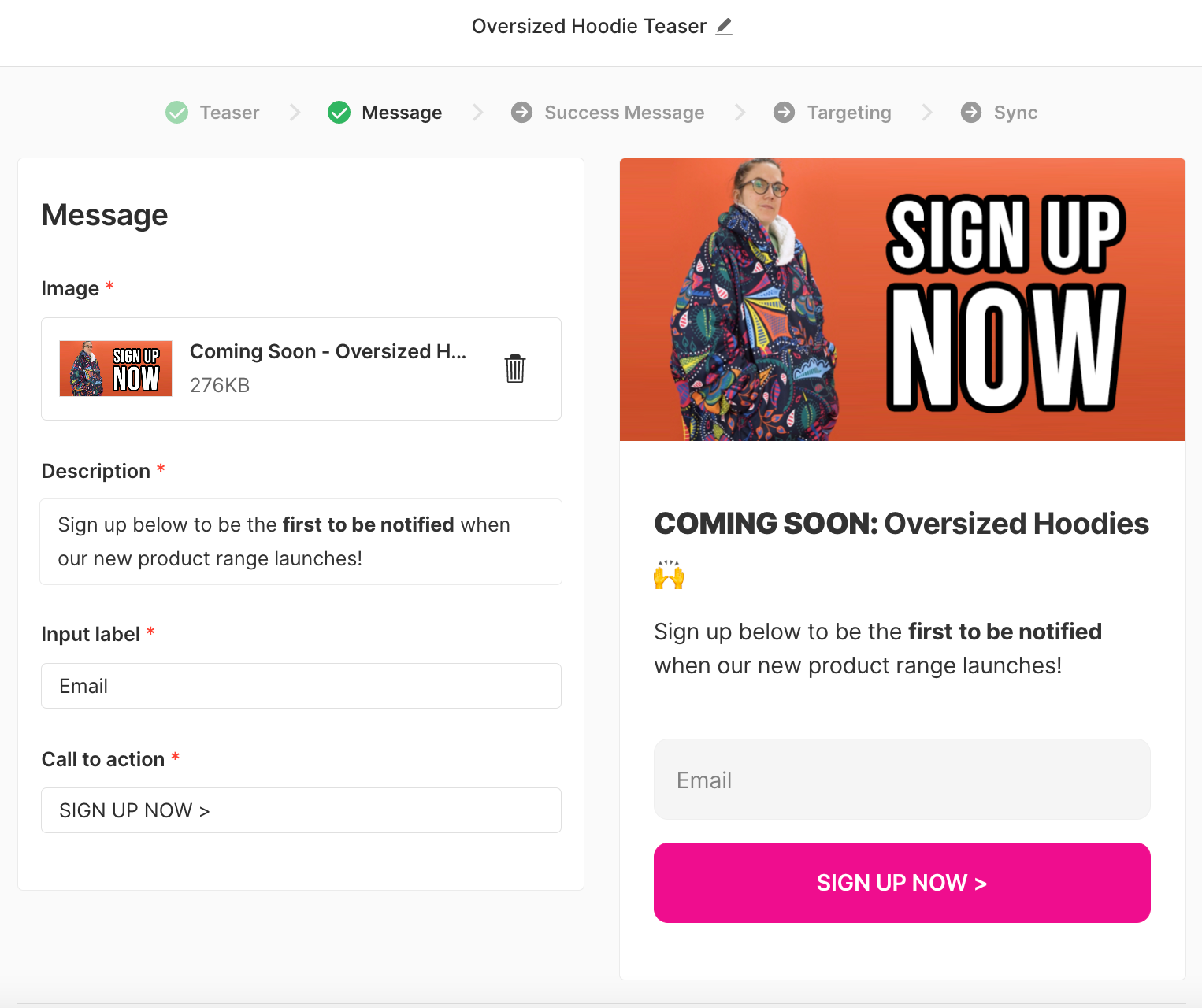
OddBalls used a "Coming Soon" sign-up form on their oversized hoodie product pages, encouraging visitors to register interest before launch.
The campaign generated nearly 700 email signups directly through the onsite notification form. By comparison, a social post directing users to a separate signup page generated only 150 signups for the same Klaviyo list.
In practice: the product alerts became a major driver of launch revenue, leading the brand to continue using notification campaigns for future product launches and promotions.
7. Qualify leads with quiz popups
Instead of leading with a discount or timing-based trigger, use a branching quiz popup that starts with a simple question and adapts to each user's answers.
This creates small micro-commitments, gathers preferences, and naturally leads to a signup step where the incentive is introduced.
Wisepops data shows these personalized survey flows can drive up to 4x more conversions. And the result is not just more contacts, but better ones: pre-qualified before they even enter your CRM.
:quality(80))
8. Keep testing and optimizing
Small tweaks in popup timing, targeting, and design can lead to major conversion gains. A/B testing helps identify which experiences drive the most engagement.
For example, OddBalls tested two spin-to-win popup campaigns: one for returning visitors and another for existing subscribers. Both used simple 5 to 10% discounts to encourage signups and purchases.
The tests showed that on-landing popups outperformed exit intent, while removing the post-close tab increased orders.
)
In practice: the campaigns delivered a 25.3% CTR, 558 conversions, and more than £31,000 in revenue, proving that small optimizations can add up quickly.
)
Analytics and data: tracking what actually matters
In ecommerce lead generation, performance tracking only matters when it ties back to revenue. The goal isn't just to collect emails, but to understand which interactions actually drive purchases.
The right tool should support flexible campaign strategies while giving clear visibility into conversion performance.
Displays
How many times visitors saw your campaigns. High displays with low engagement usually means the offer or timing needs work.
Reach
The percentage of sessions where visitors saw at least one campaign. Lower reach means tighter targeting; higher reach means broader visibility. For multiple campaigns, 30 to 50% reach is considered strong.
Clicks
The number of CTA clicks your campaigns generated. A quick indicator of engagement.
CTR
The percentage of displays that turned into clicks. Popups average around 4.8%, while top campaigns often reach 8 to 20%. Low CTR usually points to weak copy, targeting, or offers.
Emails captured
The number of leads collected. Focus on both total volume and conversion quality.
Full customer journey metrics
Metrics like revenue per visitor, average order value, bounce rate, and session duration show how lead capture influences the broader experience, not just isolated conversions.
What good performance actually looks like
The average popup conversion rate in 2026 sits at 4.82% (Wisepops data). That's your baseline.
Everything below shows how performance improves when you stop guessing and start aligning with user behavior:
After a click (high intent): up to 54% conversion rate
Interactive spin-to-win: up to 29.99% conversion rate
After 2+ page views: up to 9.8% conversion rate
With URL targeting (e.g. product pages): 5.53% vs 2.40% without targeting
Language targeting: 4.91% without targeting vs 3.11% with poor localization, a reminder that mismatched targeting can hurt more than help
The pattern is simple: the closer your timing and targeting match real user intent, the higher your conversion rate. Channel targeting, delays, triggers, and formats can all shift performance even further.
Ecommerce lead generation FAQ
What are the key requirements for ecommerce lead generation?
Successful online stores rely on a system designed to capture, qualify, and nurture potential customers. Four elements need to work together: acquisition (bringing in the right audience), onsite experience (timely and relevant prompts to turn visitors into subscribers), value exchange (a clear reason to share details, such as incentives, content, or exclusive access), and nurturing (follow-up through email, SMS, or retargeting to convert prospects into customers). When these elements work together, lead generation becomes consistent, scalable, and focused on quality, not just volume.
What should you avoid in lead generation?
Avoid treating all users the same, relying on generic or poorly timed messages, ignoring user behavior data, and focusing only on traffic instead of meaningful conversions.
Do you need a popup builder to grow your subscriber list?
Not strictly, but it makes execution significantly easier and faster. A popup builder allows you to design, test, and adjust onsite interactions without relying on code development resources. Wisepops is a code-free solution.
Should I ask for both email and phone number at once?
Only if there's a clear reason. Asking for too much upfront usually reduces conversion. Start with one field and collect more later.
How important are integrations for lead generation?
They are essential. Without integrations, the information you collect stays isolated. With the right connections, it flows directly into your email platform, CRM, or automation tools, where it can be used immediately. At a minimum: an email platform for follow-ups, a CRM to manage user relationships, and analytics tools to measure performance.
What tools should I integrate with?
At a minimum: email platforms for follow-ups, CRM systems to manage user relationships, and analytics tools to measure performance. The exact stack depends on your business, but the principle is the same: everything should be connected.
How long does it take to see results from a lead generation campaign?
Initial improvements can appear within days, especially on high-traffic stores. Clear patterns usually emerge within a few weeks as you gather enough data to refine your approach. Check our roadmap for ecommerce for a structured implementation plan.
Get started
in minutes
Start converting more visitors today.
Get started in minutes and see results right after.